 1-361-589-1048
Quick Summary
To clean vintage electronics graphic tees safely, wash them inside out in cold water on a gentle cycle with a mild detergent, and avoid bleach, fabric softener and the dryer. Hand washing and spot cleaning are safer still for rare or fragile shirts, and air drying flat keeps the print intact.
- Turn the shirt inside out and wash it in cold water, around 85°F or lower.
- Use a mild detergent at half the recommended dose and skip fabric softener.
- Never use bleach or oxygen whiteners on printed areas.
- Hand wash rare shirts, soaking them for 5 to 10 minutes without wringing.
- Air dry flat or on a padded hanger, and never put vintage tees in the dryer.
Table of Contents
- Why Vintage Electronics Graphic Tees Need Gentler Care
- Check the Care Label and Identify the Fabric and Print
- How to Wash Screen Printed Shirts Without Cracking the Design
- Hand-Washing Delicate or Valuable Vintage Shirts
- Best Detergent for Graphic Tees and Stain Removal Tips
- How to Remove Stains from Graphic Tees Without Damaging the Print
- How to Dry Graphic Tees, Remove Odors, and Store Them Safely
- Decide Whether to Wash, or When to Seek Conservation Help
- Frequently Asked Questions
How to Clean Vintage Electronics Graphic Tees Safely
Last Updated: November 2, 2026
Why Vintage Electronics Graphic Tees Need Gentler Care
Many people ask how to clean vintage electronics graphic tees without ruining the print. The short answer is that these shirts need gentler care than a plain tee. Old prints crack, fade and peel, and the cotton underneath is often thinner than what you find in new shirts.
Vintage electronics graphic tees often share a few traits:
- Thin, worn fabric that has been washed many times
- Screen-printed designs that can crack along the folds
- Bright colors that bleed or fade in hot water
- Heavy use that leaves stains, odors and yellowing
Treat the shirt like a fragile item. Clean it less often, use cold water, and skip the dryer.
Check the Care Label and Identify the Fabric and Print
Before you choose a cleaning method, identify two things: what the fabric is made of and how the graphic was applied. Vintage electronics tees can be a special case because the artwork often includes fine lettering, thin circuitry lines, and small technical diagrams.
Start with the care label. It gives fiber content and the maker's washing rules. On older shirts the label may be faded, cut out, or missing entirely, so use these tests to fill in the gaps.
Fabric identification by feel and behavior:
- 100% cotton feels soft and breathable, wrinkles easily, and absorbs water quickly. It is the most common fabric for 1980s and 1990s electronics tees.
- Cotton/polyester blends feel smoother, resist wrinkles, and dry faster. Blends are common in later vintage shirts and in promotional tees.
- 100% polyester feels slick and lightweight and dries very fast. For a comparison of these fiber choices, see organic cotton vs polyester activist tees. Older polyester can pill and hold odors differently than cotton.
- Tri-blend (cotton, polyester, rayon) feels soft and drapey. Rayon content makes the fabric weaker when wet, so handle it gently.
A quick burn test on a loose interior thread can confirm fiber content, but do it outdoors and only on a thread you can spare. Cotton smells like burning paper and leaves ash; polyester melts and smells chemical.
Print identification by look and touch:
- Screen prints feel slightly raised and firm, with ink that sits on top of the fabric. On vintage shirts the ink often cracks along fold lines and at the edges of the design. Cracks are normal and do not mean the print is failing.
- Heat-transfer or iron-on prints feel thin and plastic-like, and the edges can lift or peel. These are the most fragile and should not go through a washing machine.
- Direct-to-garment (DTG) prints feel soft and almost flush with the fabric, with a slightly grainy texture. DTG is rare on true vintage shirts but common on modern reproductions.
- Puff or high-density prints feel thick and raised. The raised areas crack and flatten over time and need extra protection.
Why electronics artwork is different:
- Fine lettering (model numbers, keyboard labels, terminal text) has thin ink lines that crack first. Once a letter cracks, it can flake away in the wash.
- Circuitry and schematic lines are usually thin and close together. Abrasion from other clothes can wear the lines down before the surrounding fabric shows wear.
- Gradient or halftone artwork (common on early computer graphics) fades unevenly and can look blotchy after hot water or harsh detergent.
- Aged or cracked prints are already compromised. Treat any visible cracking as a signal to hand-wash or spot-clean only.
Watch out: a shirt that feels stiff and smells like vinegar or camphor may have been stored with an old print that is already degrading; test a hidden area before any full wash.
How to Wash Screen Printed Shirts Without Cracking the Design
Screen prints crack when they get rubbed, twisted or heated. The steps below cut that risk.
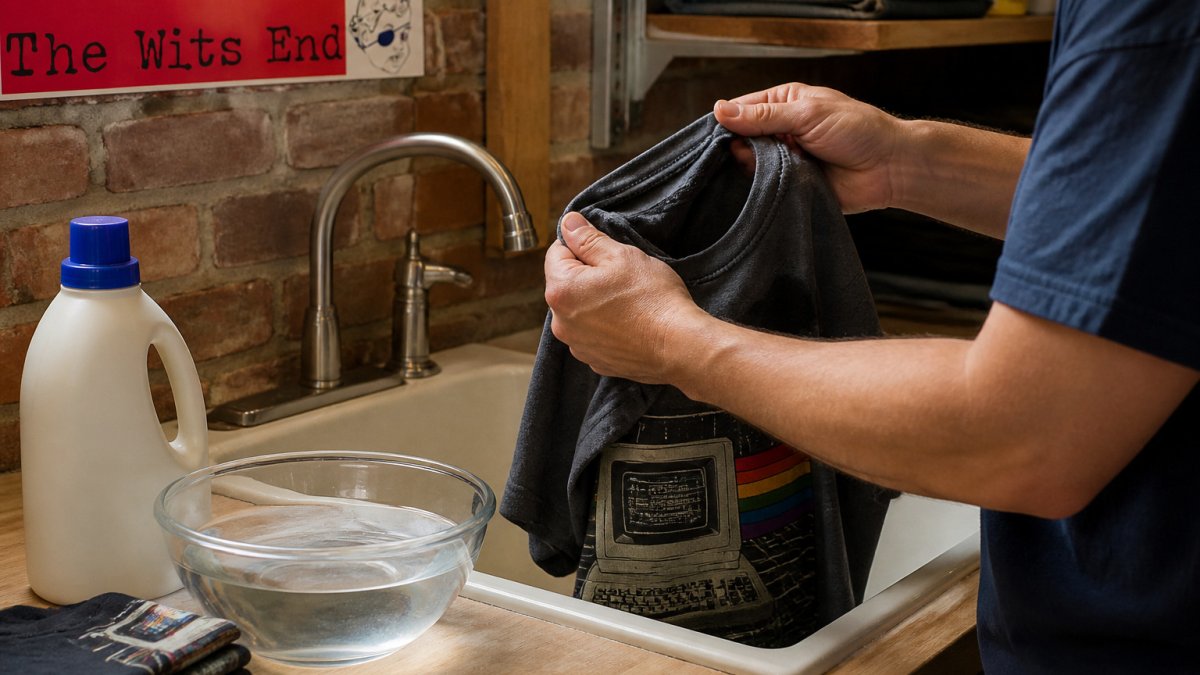
!Close-up of hands turning a vintage graphic tee inside out at a laundry room sink, with a mild detergent bottle and a bowl of cold water nearby
Turn It Inside Out and Choose a Cold, Gentle Cycle
Turn the shirt inside out before you wash it. This protects the print from rubbing against the drum and other clothes.
Then pick the gentlest setting your machine offers:
- Use a cold-water wash, around 85°F or lower.
- Choose a delicate or gentle cycle with a slow spin.
- Wash the shirt separately or with other dark, similar items.
Pick a Mild Detergent and Avoid Bleach
Choose a mild, pH-neutral detergent. Harsh detergents strip color and weaken the print over time. Skip bleach entirely, since it can yellow fabric and break down the ink.
A few rules help here:
- Use half the recommended dose of detergent.
- Never add fabric softener, which can leave a film that dulls the print.
- Do not use bleach or oxygen whiteners on printed areas.
Hand-Washing Delicate or Valuable Vintage Shirts
For rare or very fragile tees, hand washing is the safest option. If you want a sturdy vintage-style tee to compare against your own, browse the You Only Live Twice vintage zombie unisex t-shirt. You control the water temperature, the soaking time and the pressure.
- Fill a clean basin with cool water and a small amount of mild detergent.
- Turn the shirt inside out and submerge it gently.
- Soak for 5 to 10 minutes, then gently swish the water.
- Rinse with cool water until the suds are gone.
- Press out water with a towel. Do not wring or twist the shirt.
Hand washing takes more time, but it is the most reliable way to protect a shirt you care about.
Best Detergent for Graphic Tees and Stain Removal Tips
For most graphic tees, a mild liquid detergent works best. It dissolves fully in cold water and leaves less residue on prints than powder. Look for labels that say "gentle," "for colors" or "for delicates." Avoid detergents with strong brighteners, since they can dull dark designs.
Mild, color-safe detergents are a common choice for printed garments.
Atari 8-bit 'Ready' Prompt Unisex T-shirt →
How to Remove Stains from Graphic Tees Without Damaging the Print
Spot cleaning is safer than a full wash because it limits water, agitation, and detergent contact with the print.
Step 1: Identify the stain before you treat it.
- Sweat and body oil show as yellowing at the collar, underarms, and chest. They respond to a mild detergent and a short cool soak.
- Storage yellowing appears as an overall cream or brown tint, often along fold lines. It is age-related oxidation and is the hardest to reverse without damaging the print.
- Food and drink stains are usually localized and lift with cold water and a drop of mild detergent.
- Ink transfer from other garments or from the print itself looks like dark smudges. Do not use solvent-based cleaners on the printed area; they can dissolve the ink.
- Rust from hangers or storage hardware shows as orange-brown spots. Do not use bleach or oxygen whiteners on printed areas; they can lighten the ink.
Step 2: Test every cleaner on an inconspicuous area.
Turn the shirt inside out and find a hidden spot inside the hem or side seam.
Step 3: Work from the outside of the stain toward the center.
Lay the shirt flat with a clean white towel underneath.
Step 4: Rinse and check before drying.
Rinse the treated area with cold water and blot dry with a clean towel. Let the shirt air-dry completely before you judge the result.
Step 5: Treat yellowing and odor with a short cool soak.
For overall yellowing or persistent odor, soak the shirt inside out in cool water with a small amount of mild detergent for about 30 minutes.
When not to spot clean:
- The print is flaking, peeling, or sticky to the touch.
- The stain sits directly on a cracked area of the print.
- The shirt is rare or valuable and you are unsure of the fabric or ink.
- The stain is rust or an unknown chemical.
In those cases, do not wash the shirt. Consult a textile conservator or a dry cleaner with experience in vintage garments before you attempt any treatment.
How to Dry Graphic Tees, Remove Odors, and Store Them Safely
Air drying is the safest choice. Lay the shirt flat on a towel, or hang it on a padded hanger, away from direct sun. Sunlight fades colors and can dry out the print.
Do not put vintage tees in the dryer. If you must, use low heat or a no-heat setting and remove the shirt while it is still slightly damp.
For storage:
- Keep shirts folded, not hung, so the print does not stretch or crease.
- Store them in a cool, dry place away from direct light.
- Place a sheet of tissue paper between folds on heavily printed areas.
Here is a quick reference for drying, odor removal and storage, drawn from the guidance above.
| Task | Best practice | Avoid |
|---|---|---|
| Drying | Lay flat or hang on padded hanger | Dryer, direct sun |
| Dryer use (if unavoidable) | Low heat or no-heat, remove slightly damp | High heat |
| Storage | Keep folded, not hung | Hanging, stretching the print |
| Print protection | Tissue paper between folds on heavy prints | Stacking directly on printed areas |
| Storage location | Cool, dry place out of direct light | Warm or sunny spots |
Decide Whether to Wash, or When to Seek Conservation Help
Not every shirt needs a wash. To weigh whether a tee is worth keeping or replacing, see what lasts in graphic tees. If a tee looks clean and smells fine, spot clean it or leave it alone. Washing too often speeds up wear.
Seek professional help if the shirt is rare, very old or has a delicate print you cannot replace. A textile conservator can advise on safe cleaning. Shirts with flaking or peeling prints should be handled carefully and not washed at all until you know the risk.
Cleaning a vintage electronics graphic tee safely comes down to gentle care: cold water, mild detergent, no bleach, no dryer, and no wringing. If you are shopping for a durable replacement, browse our Atari 8-bit 'Ready' Prompt Unisex T-shirt, which is made from 100% combed and ring-spun cotton and pre-shrunk fabric.

Frequently Asked Questions
Should you turn a graphic tee inside out before washing it?
Yes. Turning a graphic tee inside out before washing keeps the printed side from rubbing against the drum, zipper, and other garments, which is the main cause of cracking and fading on screen-printed designs. It also protects the print from direct contact with the detergent and agitation. Once the shirt is inside out, place it in a mesh laundry bag for extra protection, especially with vintage or electronics-themed designs that have fine lines or small text. This simple step costs nothing and does more to preserve the print than most other precautions.
What water temperature is safest for vintage graphic tees?
Cold water is the safest choice for vintage graphic tees in the United States. Warm and hot water accelerate color fading, cause the print to crack, and can shrink aged cotton. Most washing machines offer a cold setting that still cleans effectively when paired with a mild detergent. Cold water also reduces the risk of the fabric losing its shape over time. If a stain needs more heat to lift, test a small area first, but for routine washing, keep the temperature cold every time.
Can you put vintage graphic tees in the dryer?
It is best to avoid the dryer. High heat can crack screen-printed designs, shrink aged cotton, and make the fabric stiff and thin. Instead, air dry vintage graphic tees flat on a towel or hang them on a padded hanger, away from direct sunlight, which can fade colors. If you must use a machine, choose the lowest heat or an air-only setting and remove the shirt while it is still slightly damp. Reshape the garment by hand while drying to keep the collar and hem from warping.