 1-361-589-1048
Last Updated: November 4, 2026
Quick Summary
To spot authentic vintage sci-fi apparel, check the tag and hem first: a paper care label and single-stitch hem usually mean the shirt was made before the mid-1990s, while a double-stitched hem and printed neck label point to a later run. Confirm the print feels raised with natural fade, the hardware shows patina, and the licensing line matches the era.
- Run your thumb along the bottom hem: one row of thread is older, two rows is newer.
- A paper care label sewn into a side seam is a strong period cue.
- Real vintage shirts were usually screen printed with plastisol ink that feels thick and rubbery.
- Puff ink ages by flattening and cracking along the edges of the raised areas.
- A shiny, brand-new zipper on a shirt claimed as 1980s is a giveaway.
Table of Contents
- Start With the Tag: How to Date a Vintage T-Shirt
- Reading Vintage T-Shirt Tags and Labels Like a Collector
- Vintage Shirt Print Identification: Screen Print, Plastisol, and Graphic Integrity
- Check the Hardware: Zippers, Pulls, and Patina
- Fabric Composition, Material Weight, and Textile Aging
- The Vintage Clothing Condition Checklist for Sci-Fi Shirts
- Reproduction vs. Bootleg vs. Original: Telling Them Apart
- Smell Testing and Digital Provenance Verification
- What to Do With What You Have Learned
- Frequently Asked Questions
Start With the Tag: How to Date a Vintage T-Shirt
The fastest way to tell real vintage sci-fi apparel from a modern reprint is the tag. A single-stitch hem and a paper care label usually mean the shirt was made before the mid-1990s, while a double-stitched hem plus a printed neck label points to a later run.
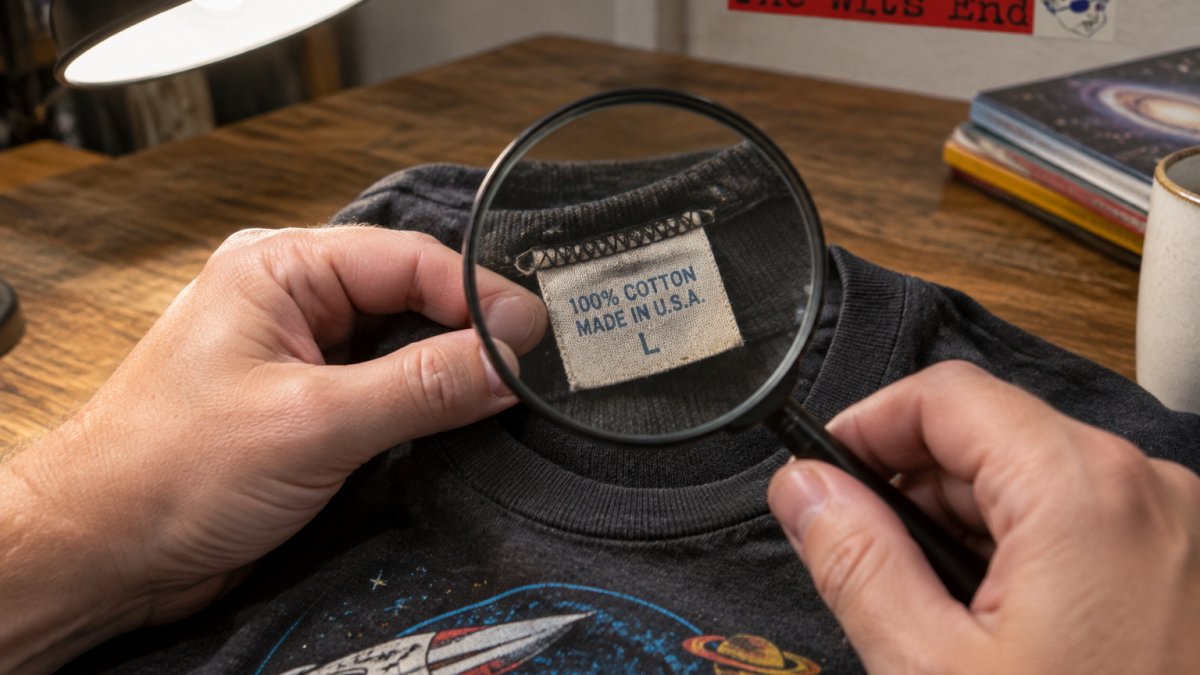
Single-Stitch vs. Double-Stitch Construction
A single-stitch hem is one line of thread along the bottom edge. It was standard on most shirts up to the 1990s. A double-stitch hem uses two parallel lines and became common later.
Run your thumb along the bottom hem. One row of thread? Older. Two rows? Newer. This one check rules out most fakes in seconds. The Federal Trade Commission's textile and wool rules require accurate fiber and origin labels, so a tag that skips that info is a red flag.
Reading Vintage T-Shirt Tags and Labels Like a Collector
Paper care labels and older fabric tags are the collector's cheat sheet. They tell you the decade, the maker, and often the country of origin. Modern reprints rarely copy them well, and the ones that try usually slip on typography or label material.
Look for these clues:
- Paper care labels that feel stiff or slightly yellowed
- "Union made" stamps with a visible union logo
- Copyright dates printed in small type
- Licensing info naming the original studio or brand
- Manufacturing origin stated as a country, not a city
Union Tags, Copyright Dates, and Licensing Info
A union tag is one of the strongest signs of a genuine older shirt. It shows the garment was made in a union shop, common in past decades. The tag itself changed over time, so the union logo, the wording, and the thread color are all dating tools.
Copyright dates and licensing lines are just as useful. A real licensed sci-fi tee usually carries a studio or rights-holder line, sometimes with a year. If the shirt claims to be from the 1980s but lists a studio that did not exist yet, walk away. The same logic applies to the rights holder: a design tied to a film that came out in 1987 cannot honestly carry a 1982 copyright line.
Label Typography and Font Cues
Typography is where most reproductions fail. Older labels were typeset with the technology of the time, so the letterforms, spacing, and print quality reflect that. Look for slightly uneven baseline alignment, ink that sits on the surface of the label rather than soaking in, and font styles that match the decade. A clean, perfectly kerned sans-serif on a label that claims to be from the 1970s is a warning sign. Compare the label font to known examples from the same maker and era; collectors often share tag photos for exactly this reason.
Care Label Material and Placement
Care label material changed over the decades. Early labels were often paper or a stiff coated paper that yellows and curls at the edges. Later labels moved to woven or printed synthetic materials that feel smoother and resist staining. Placement matters too: older shirts tend to have the care label sewn into a side seam or the lower inside hem, while many modern shirts print the care info directly onto the neck label. A paper care label sewn into a side seam is a strong period cue; a printed neck label with a modern care icon set is not.
Watch out: a seller who photographs only the front graphic and never the tag, hem, or care label leaves out the details you need to date the shirt.
Vintage Shirt Print Identification: Screen Print, Plastisol, and Graphic Integrity
Real vintage shirts were usually screen printed with plastisol ink. That ink sits on top of the fabric and feels thick and rubbery. It also fades in a natural, uneven way over time. But plastisol is only one branch of the family, and sci-fi apparel used several print methods that each age differently.
Here is how to read the print:
- Feel the ink. Raised and slightly tacky? Likely plastisol.
- Check the fade. Even, blotchy wear is normal. Perfect color is suspicious.
- Look at the edges. Crisp, sharp lines suggest a modern digital print.
- Check graphic integrity. Cracks and tiny pinholes are common in old prints.
Sci-Fi Specific Iconography Authentication
Sci-fi shirts carry their own tells. Look at the font, the logo shapes, and the copyright line. A real retro sci-fi tee matches the era's actual branding, not a modern redraw. Classic 8-bit and text-adventure designs are a good test case. If you want a reference point, our Grue Warning: Classic 8-Bit Text Adventure t-shirt shows how authentic retro text-adventure graphics should look, and our Atari St Power Without The Price Unisex T Shirt is a solid example of genuine vintage-style Atari branding for comparison.


Puff Ink vs. Plastisol vs. Water-Based Ink
Sci-fi graphics from the late 1970s through the 1990s often used puff ink, a plastisol additive that expands under heat to create a raised, foam-like texture. Puff ink is common on bold logo treatments and on designs meant to feel three-dimensional. It ages by flattening and cracking in a distinctive way: the raised areas compress first, and the cracks tend to follow the edges of the puff. Standard plastisol stays flatter and cracks in finer, more random lines. Water-based ink soaks into the fabric instead of sitting on top, so it feels soft to the touch and fades by thinning out rather than cracking.
Licensing Marks and Bootleg Print Tells
Licensing marks are the fastest way to separate an official original from a bootleg. Official licensed sci-fi apparel usually carries a studio or rights-holder line, often with a copyright year, and the print quality tends to be consistent across the run. Bootlegs from the same era can still be collectible, but they usually skip the licensing line, use a generic or redrawn logo, and print with cheaper ink that cracks heavily or flakes. A reproduction made later may carry a modern licensing line and a digital print with crisp edges.
Grue Warning: Classic 8-Bit Text Adventure t-shirt →
Watch out: heavy cracking alone does not prove age, because a cheap modern bootleg can crack within a few washes; pair the crack pattern with the ink type and the licensing line before you decide.
Check the Hardware: Zippers, Pulls, and Patina
Zippers and pulls are a quick way to spot a fake. Old hardware shows hardware patina: dull metal, worn paint, and a slightly stiff pull. A shiny, brand-new zipper on a "1980s" shirt is a giveaway.
Check the brand stamped on the pull. Many older zippers carry maker names that changed over the decades. Match that name to the era the shirt claims to be from.
Fabric Composition, Material Weight, and Textile Aging
Old cotton feels different. It is softer, thinner, and often lighter than a new shirt. Textile aging shows up as small pills, a slight stretch at the collar, and a gentle fade across the whole garment.
A cotton blend or high polyester content changes how a shirt ages. Polyester holds color longer but can feel slick. Pure cotton fades and softens. Feel the material weight in your hand: heavier, denser fabric usually points to an older, sturdier run. For hands-on care advice, our guide on how to clean vintage electronics graphic tees safely walks through washing without wrecking the print.
The Vintage Clothing Condition Checklist for Sci-Fi Shirts
Use this checklist before you buy or wear a find. It covers the details that matter most for collectible apparel.
- Tag is paper or shows a union mark
- Hem is single-stitched
- Print feels raised and shows natural fade
- No modern digital-print edges
- Hardware shows patina
- Smell is clean, no chemical or musty odor
- Collar holds shape without heavy stretching
- Graphic is intact, no major cracks or holes
If you plan to wear your find to a con, our guide on the 7 best clothing materials for gaming convention comfort helps you pick what stays comfortable all day.
Run through these checks before you buy or wear a find.
| Check | What to look for |
|---|---|
| Tag | Paper label or visible union mark |
| Hem | Single-stitched construction |
| Raised ink with natural fade | |
| Print edges | No modern digital-print edges |
| Hardware | Zippers and pulls show patina |
| Smell | Clean, no chemical or musty odor |
| Collar | Holds shape without heavy stretching |
| Graphic | Intact, no major cracks or holes |
Reproduction vs. Bootleg vs. Original: Telling Them Apart
Three labels get mixed up constantly. Here is the difference:
- Original: Made in the era it depicts, with period tags and print.
- Reproduction: A licensed or official reprint made later.
- Bootleg: An unauthorized copy, often modern and low quality.
A reproduction can still be a good buy if it is labeled honestly. A bootleg usually skips licensing info and uses cheap digital prints. If you want modern niche designs instead of hunting originals, you can find your niche graphic tee in our shop.
Smell Testing and Digital Provenance Verification
Two checks most guides skip: smell and provenance. A genuine old shirt smells like clean cotton or mild storage. A sharp chemical or perfume smell can hide mold or a fresh print.
Provenance means the shirt's history. Ask for photos of the tag, the hem, and the print. Sellers who document these details are usually trustworthy. A quick reverse image search can also reveal if a "rare" design is actually a mass reprint.
What to Do With What You Have Learned
Spotting authentic vintage sci-fi apparel comes down to a few sharp checks: the tag, the stitch, the print, the hardware, and the smell. Practice on a few thrift finds and the patterns become obvious fast. When you want fresh retro designs without the guesswork, The Wits End makes apparel and stickers celebrating geek culture and retro tech, with sizes up to 5XL.
Frequently Asked Questions
How can you tell if a sci-fi T-shirt is truly vintage?
Check the tag first. Single-stitch hems, paper care labels, and union-made markings point to older production. Then look at the print: vintage sci-fi shirts usually have a soft, cracked plastisol or screen print with visible ink texture, not a slick digital finish. Copyright dates and licensing info printed near the graphic also help confirm the era.
How can you tell a vintage shirt from a modern reproduction?
Modern reproductions often use double-stitched hems, heat-transfer or DTG prints, and synthetic-feeling fabric. Authentic vintage pieces show single-stitch construction, paper care labels, and a print that has aged with the fabric. Check the label font and manufacturing origin too, since repros frequently reuse modern tag designs that did not exist when the original graphic was made.
What details should you check on a vintage graphic T-shirt?
Start with the vintage T-shirt tags and labels for union marks, copyright dates, and fabric content. Then inspect the stitch pattern and hem finish, the print method and graphic integrity, and the hardware patina on any zippers. A vintage clothing condition checklist should also cover fade patterns, serged seams, and smell, since musty odor can signal long storage or water damage.
Are vintage sci-fi shirts valuable?
Value depends on the title, era, and condition. Deadstock shirts with intact graphics and original tags command the most, while worn pieces with cracked prints sell for less. Sci-fi specific iconography authentication matters here: licensed movie and game graphics with clear copyright dates and licensing info hold value better than bootlegs. Condition, provenance, and rarity drive final prices.