 1-361-589-1048
Quick Summary
To start a screen printing business at home, define your product and buyer, then check local zoning, permits, insurance, and sales tax before taking orders. Begin with a manual press and a few screens, and run a small test order to confirm demand and real costs.
- Pick a niche such as band tees, team jerseys, or local event shirts before buying equipment.
- Ask your zoning office in writing whether a home print shop is permitted and under what conditions.
- Homeowner's policies typically exclude business equipment, so ask about a BOP or general liability policy.
- Solvents and heat sources are flammable, so check fire-safety and extinguisher requirements.
- Price spoilage and reprints into every quote, since they can erase your margin on a whole order.
Table of Contents
- How to Start a Screen Printing Business at Home
- What You Need Before You Print Your First Shirt
- Checking Zoning, Permits, Insurance, and Taxes for a Home Shop
- Screen Printing Equipment for Beginners
- Screen Printing Business Startup Costs and Budget Planning
- How to Price Screen-Printed Shirts Without Losing Money
- How to Get Screen Printing Customers for a Home Shop
- Your Next Step: Run a Test Order Before You Buy Everything
- Frequently Asked Questions
How to Start a Screen Printing Business at Home
Last Updated: November 6, 2026
Starting a screen printing business at home is one of the most affordable ways to launch a custom apparel shop in the United States. You can start with a small manual press and a corner of a garage or spare room. The catch is that home shops run into zoning rules, permits, insurance questions, and sales tax before the first shirt ships. This guide walks through each step in order, so you know what to set up before you spend money.
The Wits End is a veteran-owned shop in Corpus Christi, Texas, that creates on-demand, hand-screened, and direct-to-garment apparel.
What You Need Before You Print Your First Shirt
Before you buy ink, decide what you plan to sell and who will buy it. A screen printing business is really a small production shop, so the first job is to define the product and the customer.
Start with three questions:
- What will you print? Pick a niche such as band tees, team jerseys, or local event shirts.
- Who is your buyer? Schools, small businesses, and hobby groups each order differently.
- How many shirts can you produce each week? Your press speed sets your real capacity.
Watch out: Many beginners buy equipment for a product they never sell. Test demand with a small order before you commit to a large setup.
Next, prepare your artwork. Most screen printing needs vector files, or a clean image that can be separated into one layer per ink color. Learn basic color separation early, because it affects every print you make.
Checking Zoning, Permits, Insurance, and Taxes for a Home Shop
For a home print shop, the rules are often the hard part, because screen printing combines solvents, water use, heat, noise, deliveries, and occasional customer visits in a residential space. Work through the items below before you take a single order.
Zoning and home-occupation rules. Your city or county zoning office decides whether a home business is allowed at your address and under what conditions.
Fire and building safety. Screen printing involves flammable solvents, aerosol adhesives, and heat sources. Your local fire marshal may require a fire extinguisher rated for chemical fires, safe storage of solvents in approved containers, and clearance between your dryer or flash unit and combustible surfaces.
Wastewater and cleanup. Washout sinks send emulsion and ink residue into the drain. Some municipal sewer authorities prohibit discharging screen-printing waste, and a home septic system is especially vulnerable.
Business registration. Register your business name with your state, and check whether your city requires a general business license in addition to the home-occupation permit. The U.S. Small Business Administration outlines general registration steps at sba.gov, but the forms themselves are filed with your state and county.
Seller's permit and sales tax. Selling apparel generally means collecting sales tax. Apply for a seller's permit through your state revenue department, and confirm whether your state taxes garments differently from other goods. Keep records of exempt sales, such as resale certificates from business customers.
Insurance. A standard homeowner's policy typically excludes business equipment and business liability.
Federal and state taxes. Business income goes on your federal return, usually on Schedule C if you operate as a sole proprietor (About Schedule C (Form 1040), Profit or Loss from Business (Sole Proprietorship)). A home office deduction is available only for space used regularly and exclusively for business, so a corner of a shared room generally does not qualify (How small business owners can deduct their home office from their taxes).
Watch out: Rules change and vary block by block. Confirm each item with your own city, county, and state offices rather than relying on a general guide, and keep copies of every permit and approval.
Before you take an order, these are the main compliance items a home shop needs to check, with what to confirm for each.
| Item | What to confirm | Why it matters |
|---|---|---|
| Zoning and home-occupation rules | Permitted space, customer visits, employees, signage | Light manufacturing can trigger stricter rules |
| Fire and building safety | Chemical-rated extinguisher, solvent storage, dryer clearance | Solvents and heat sources are flammable |
| Wastewater and cleanup | What the sewer authority allows, filter or settle tank | Emulsion and ink can harm drains and septic systems |
| Seller's permit and sales tax | State registration, garment tax rules, resale certificates | Selling apparel generally means collecting sales tax |
| Insurance | BOP or general liability covering the home shop | Homeowner's policies typically exclude business equipment |
| Home office deduction | Space used regularly and exclusively for business | A shared corner of a room generally does not qualify |
Screen Printing Equipment for Beginners
Your equipment choice depends on your budget and how many shirts you expect to print each week. A manual press with a few screens works for a small start. A larger shop may need an automatic press later.
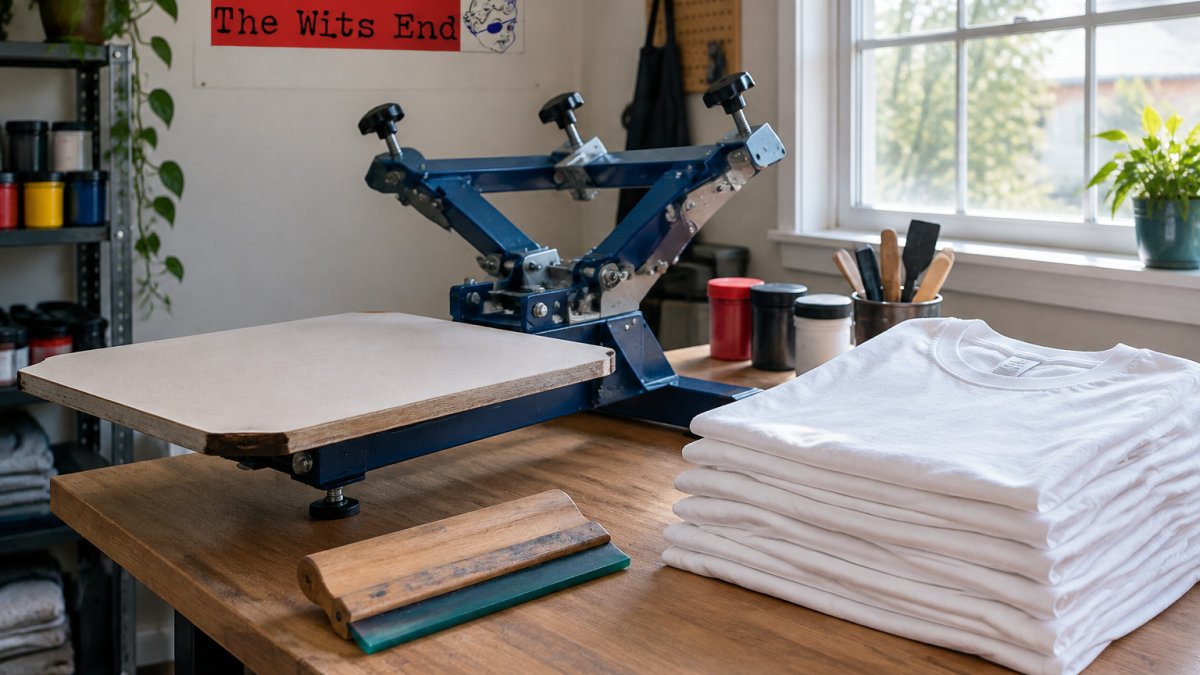
A basic beginner setup includes:
- A manual press: A single-color or multi-station press holds the garment and the screen in place.
- Screens and mesh: Screens hold the stencil. Mesh count affects detail and ink flow.
- Emulsion and an exposure unit: Emulsion coats the screen, and light hardens the parts you don't want ink to pass through.
- Squeegees: Use them to push ink through the open areas of the screen.
- Ink: Plastisol and water-based inks each suit different fabrics and finishes.
- A heat source: A dryer or flash unit cures the ink so the print lasts through washing.
Start with a manual press and one or two colors. You can add stations and automation once orders justify the cost.
Screen Printing Business Startup Costs and Budget Planning
Startup costs for a home screen printing shop fall into three tiers, and the tier you choose should match the order volume you can realistically sell. Rather than quote a single number, build your budget from the categories below and get current quotes from suppliers, because equipment and garment prices move.
Tier 1, Test the market (lowest spend). A single-color manual press or a starter kit, a few screens, emulsion, a squeegee, plastisol ink, and a heat gun or household iron for curing. You outsource exposure at a local shop or use a DIY exposure setup.
Tier 2, Small production shop. A multi-color manual press, a proper exposure unit, a flash dryer for curing between colors, and a conveyor or infrared dryer for final curing. This is the tier most home shops settle into because it supports multi-color work and repeatable quality without the cost of automation.
Tier 3, Growth setup. An automatic press, a conveyor dryer sized for your volume, a washout booth, and a dedicated ventilation system. Only move here when order volume justifies the payment and the space.
Budget categories to plan for:
- Equipment (press, screens, exposure unit, dryer, flash unit)
- Consumables (ink, emulsion, squeegees, adhesive, cleaning supplies)
- Garments and blanks, including spoilage
- Registration, licenses, permits, and insurance
- Marketing, samples, and a simple website or marketplace listing
- Utilities, especially electricity for the dryer and water for washout
Unit economics and break-even. The number that matters is contribution margin per shirt: price minus garment cost, ink and consumables, labor, spoilage, packaging, and a share of overhead. A common pattern is that small runs carry a much higher cost per shirt than large runs because setup time is spread over fewer pieces.
Watch out: Beginners often budget for the press but not for the dryer, ventilation, or spoilage. A press without a reliable curing method produces shirts that crack or wash out, and reprints erase the margin on the whole order. Price spoilage into every quote.
Track every cost from the first order in a simple spreadsheet with columns for garment, ink, labor, overhead, and spoilage. Update your quotes as supplier prices change, and revisit your break-even volume each quarter as your fixed costs shift.
How to Price Screen-Printed Shirts Without Losing Money
Pricing mistakes sink many home shops. Start by adding up your real cost per shirt, then add a profit margin and a buffer for waste and reprints.
Use this simple method:
- Garment cost: The price you pay for the blank shirt.
- Ink and consumables: The amount of ink and supplies each print uses.
- Labor: The time you spend per shirt, valued at a fair hourly rate.
- Overhead: A share of utilities, insurance, and equipment costs.
- Profit margin: Add a percentage that leaves room to grow.
Test your price on a real order before setting it for every customer. Small runs cost more per shirt, so price them higher or set a minimum order size.
Pricing depends on quantity, garment type, number of colors, and delivery timing. For current prices of specific products, check The Wits End's website or request a quote directly.
How to Get Screen Printing Customers for a Home Shop
Customers rarely arrive on their own. Pick two or three channels and focus on them.
Good starting points include:
- Local groups: Schools, churches, sports leagues, and small businesses often order team or event shirts.
- Social media: Post before-and-after photos of finished jobs.
- Online marketplaces: Etsy and similar sites let you sell designs without building a full website first.
- Referrals: Ask happy customers to recommend you to their networks.
A common mistake is taking every order at any price. Choose the customers who fit your capacity and pay fair rates.
Your Next Step: Run a Test Order Before You Buy Everything
Before you spend on a full setup, run one small test order from start to finish. Print a few shirts, track your costs, and deliver them to a real customer. This shows you where the workflow breaks, how long each step takes, and what the true cost per shirt is.
Once the test order works, expand your equipment and marketing in stages. Keep your records clean, check your local rules each year, and let your sales guide each new purchase.
Frequently Asked Questions
What equipment do you need to start screen printing at home?
At minimum you need a screen with mesh stretched on a frame, emulsion and an exposure unit or sunlight, a squeegee, water-based or plastisol ink, a manual press or a sturdy platen setup, a heat source such as a flash dryer or conveyor for curing, and garment blanks. Many home beginners start with a single-color manual press and a small exposure setup, then add color and capacity as orders grow. Confirm current equipment prices and availability directly with suppliers, since costs vary by brand and quantity.
Can you screen print shirts in a small home workspace?
Yes, many home shops run from a spare room, garage, or corner of a basement. You need enough floor space for the press, a drying area, and storage for screens, inks, and blanks, plus good ventilation and a clean, level surface. Keep ink and emulsion away from food areas and store chemicals safely. Check your lease or HOA rules and local zoning before setting up equipment at home.
What permits do you need to start a home-based screen printing business?
Requirements depend on your city, county, and state. Most home businesses need a general business license or registration, and you may need a home occupation permit if zoning restricts commercial activity. If you sell taxable goods, you will likely need a seller's permit to collect sales tax, and you should obtain an employer identification number if you hire staff. Contact your local city or county clerk and your state revenue or tax agency to confirm what applies to you. Also ask your insurance provider about general liability coverage for a home shop.
How do you price screen-printed shirts for profit?
Start with your total cost per shirt: blank garment, ink, screen and setup time, labor, electricity, packaging, and shipping supplies. Add a share of fixed costs such as equipment depreciation and software, then add your target profit margin. Compare that cost against what your customers will pay. Your break-even point is your fixed monthly costs divided by your profit per shirt. Review pricing as your costs change, and test prices on small batches before committing to them for larger orders.