 1-361-589-1048
Last Updated: October 24, 2026
Quick Summary
To price custom apparel for profit, calculate your total unit cost (blanks, decoration, labor, packaging, shipping, and fees), then divide that cost by (1 minus your target margin). For example, a $12 unit cost at a 60% gross margin gives a $30 selling price. Always quote to gross margin, but review net margin monthly to confirm the business is profitable.
- Markup is cost plus a percentage, while gross margin is profit after direct costs shown as a percent of selling price.
- A 48-piece screen-printed order at $11.18 per shirt priced at $24.99 yields about $567.95 net profit.
- Break-even units = (Setup A - Setup B) / (Unit cost B - Unit cost A), which was 25 pieces for screen print versus DTG.
- A 20% discount on a 50% gross margin item cuts gross profit per unit by 40%.
- Add a 5-10% buffer to every quote to absorb hidden costs like misprints, returns, and rush labor.
Table of Contents
- Why Most Custom Apparel Pricing Fails Before the First Sale
- The Custom Apparel Cost Breakdown That Sets Your Floor
- The Custom Apparel Pricing Formula: Markup, Gross Margin, and Net Margin
- Custom T-Shirt Pricing Examples From Quote to Net Profit
- Wholesale Custom Apparel Pricing for Bulk and Repeat Orders
- Hidden Costs That Quietly Eat Your Margin
- Setting a Target Margin and Testing Your Price
- Build Your Own Quote Worksheet Before You List a Single Shirt
- Frequently Asked Questions
Why Most Custom Apparel Pricing Fails Before the First Sale
Most shirt pricing fails before a single shirt sells. The reason is simple: the seller sets a price by guessing, then discovers the real cost later.
Here is the core problem. A custom apparel quote has to cover blanks, ink, labor, shipping, fees, and still leave something for you.
Below, we break down how to price custom apparel for profit, step by step, with a worksheet you can copy today.
The Custom Apparel Cost Breakdown That Sets Your Floor
Your floor price is the total cost to produce one shirt. Nothing below that number is a real business. A custom apparel cost breakdown has two halves: what you buy, and what you do.
Blank Garments and Material Costs
Start with the blank. A basic cotton tee, a ring-spun upgrade, and a heavyweight option all carry different costs.
Then add the extras:
- Ink or vinyl for the design
- Screens or transfer sheets
- Packaging, bags, and tissue
For a deeper look at how printing methods shape your material and decoration costs, see our guide to personalized merch.
Decoration, Labor, and Overhead
Decoration is where quotes drift. Screen printing charges by color and by print size. Heat transfer vinyl charges by sheet and by cut time.
Labor covers setup, pressing, folding, and packing. Overhead covers rent, equipment wear, software, and your own hours.
Knowing how to identify high quality screen printing helps you price labor honestly, because a clean print takes more care than a rushed one.
The Custom Apparel Pricing Formula: Markup, Gross Margin, and Net Margin
Three numbers run every profitable shop: markup, gross margin, and net margin. Most sellers mix them up, and that is where pricing breaks.
Markup is cost plus a percentage. If a shirt costs you $10 and you mark it up 100%, you sell at $20.
Gross margin is profit after direct costs, shown as a percent of the selling price.
Net margin is what remains after overhead, fees, and shipping. This is the number that pays you.
Use this simple formula as your custom apparel pricing formula:
- Selling price = unit cost ÷ (1 - target margin)
If your unit cost is $12 and you want a 60% gross margin, divide $12 by 0.40. Your price is $30.
Custom T-Shirt Pricing Examples From Quote to Net Profit
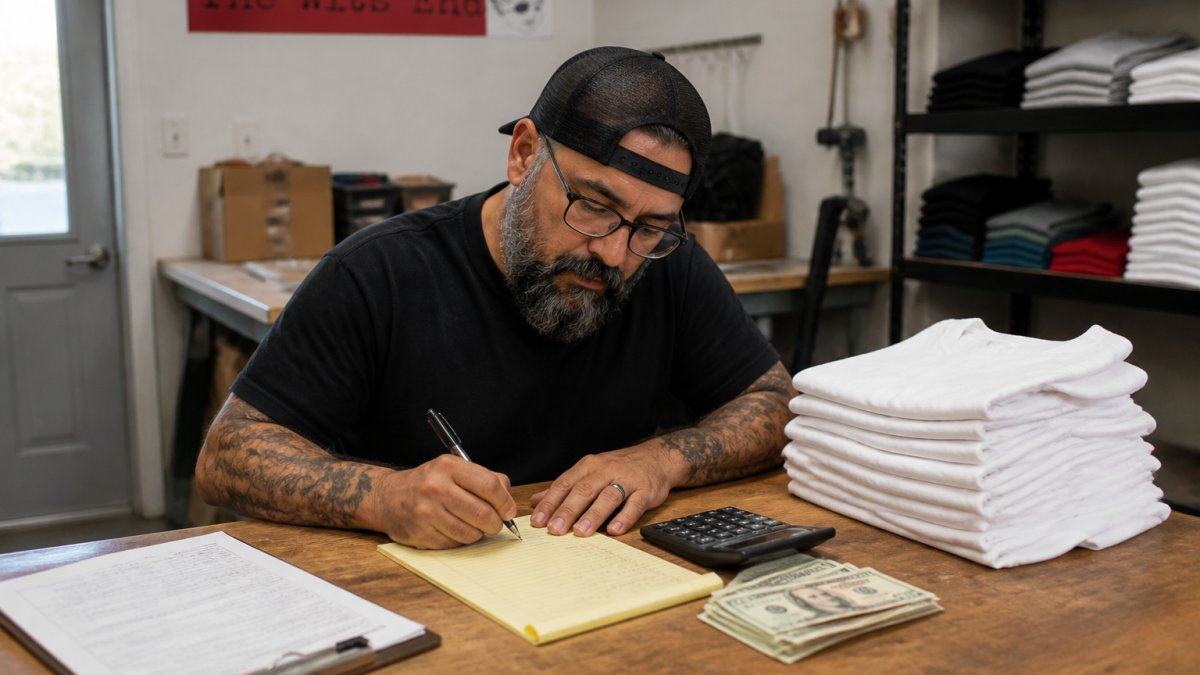
A pricing formula only proves itself when you run a real order through it. You can also review the custom screen printed apparel offering this business provides.
Worked example: 48 custom tees, screen printed
Assume a mid-weight ring-spun cotton tee at $5.75 per blank, a two-color front print, and a one-color sleeve hit. Here is the line-item quote a shop would build:
| Line item | Basis | Amount |
|---|---|---|
| Blanks (48 @ $5.75) | Per unit | $276.00 |
| Screen setup (3 screens @ $25) | One-time | $75.00 |
| Ink and emulsion | Per unit | $0.90 x 48 = $43.20 |
| Print labor (press time) | Per unit | $1.40 x 48 = $67.20 |
| Fold, bag, and pack | Per unit | $0.60 x 48 = $28.80 |
| Outbound shipping | Per order | $38.00 |
| Payment processing (2.9% + $0.30) | On revenue | See below |
| Spoilage allowance (3%) | On blanks | $8.28 |
Direct cost before processing fees: $536.48, or about $11.18 per shirt.
Now set the sell price. If the shop targets a 55% gross margin, price = unit cost / (1 - 0.55).
Processing fees at 2.9% + $0.30 per transaction: $1,199.52 x 0.029 = $34.79, plus $0.30 = $35.09. Net after direct costs and fees: $1,199.52 - $536.48 - $35.09 = $627.95.
Now allocate overhead.
The same job across four decoration methods
Method choice changes both the cost structure and the break-even quantity. The numbers below are typical ranges small shops report; your own supplier quotes will vary.
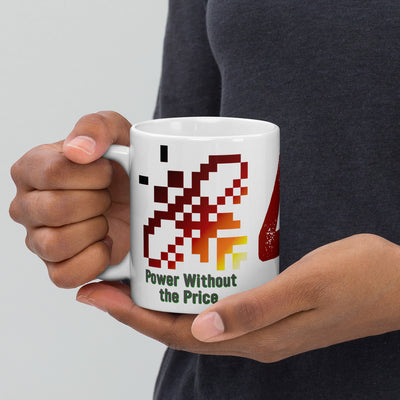
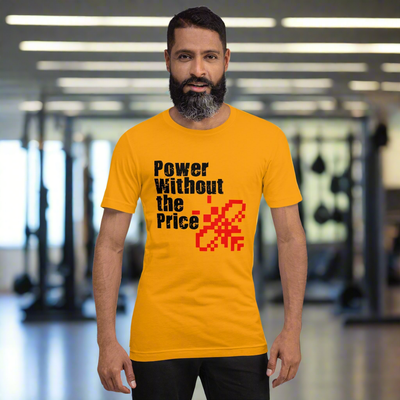
Atari ST Power Without the Price Unisex T-shirt →
| Method | Setup / minimum | Per-unit decoration cost | Break-even vs. DTG |
|---|---|---|---|
| Screen print | $20-$30 per screen; often 12-24 piece minimum | $1.00-$2.50 at 48 pieces, falling with volume | Cheaper than DTG above roughly 24-36 pieces |
| Direct-to-garment (DTG) | Low setup; no screen charge | $3.00-$6.00 per print, flat across quantities | Best for short runs and photo-real art |
| Embroidery | $25-$75 digitizing; per-head stitch cost | $2.50-$6.00 depending on stitch count | Cheaper than screen print below roughly 12 pieces on left-chest logos |
| Heat transfer vinyl | Low setup; cut time per sheet | $2.00-$4.50 including weeding and pressing | Competitive on one-color names and numbers |
A practical rule: run the break-even math before you quote. If a customer wants 10 pieces with a three-color design, screen print setup alone may push the per-unit cost above DTG. Quoting screen print at a 10-piece volume can quietly lose money even at a healthy-looking margin.
Break-even quantity math
Break-even quantity is the order size where two methods cost the same. The formula:
Break-even units = (Setup A - Setup B) / (Unit cost B - Unit cost A)
Example: screen print setup is $75 and per-unit decoration is $1.50; DTG setup is $0 and per-unit decoration is $4.50. Break-even = ($75 - $0) / ($4.50 - $1.50) = 25 pieces. Below 25, DTG is cheaper; above 25, screen print wins. Quote the method that fits the quantity, not the method you prefer.
Wholesale Custom Apparel Pricing for Bulk and Repeat Orders
Bulk orders change the math, but not the rule: every discount must clear your contribution margin. Wholesale custom apparel pricing usually drops the per-unit price because setup costs spread across more shirts, but a discount that ignores variable cost per unit can turn a big order into a small loss.
Contribution margin is your discount floor
Contribution margin is revenue minus variable costs (blanks, ink, labor, packaging, processing fees, shipping). It is what each order contributes toward overhead and profit. Before you set any tier, calculate it:
Contribution margin per unit = Sell price - Variable cost per unit
If a shirt sells for $22 and variable cost is $11.18, contribution margin is $10.82 per unit. A volume discount can reduce price only until contribution margin still covers the incremental overhead the order creates (extra labor hours, rush shipping, storage). A common pattern is to set a floor at 1.5x to 2x variable cost per unit for bulk tiers, then test whether the order still clears overhead.
A tiered price schedule that protects margin
Instead of flat percentage discounts, build tiers around setup-cost recovery and capacity. For a side-by-side look at how this business stacks up against a major competitor, see Customink Vs Creativecustomizing Custom Apparel Printing. Here is a sample schedule for the same screen-printed tee:
| Quantity | Setup treatment | Per-unit price | Contribution margin per unit |
|---|---|---|---|
| 12-23 | Full setup charged | $27.99 | $16.81 |
| 24-71 | Setup spread across order | $24.99 | $13.81 |
| 72-143 | Setup absorbed; volume ink pricing | $22.49 | $11.31 |
| 144+ | Setup absorbed; scheduled production | $20.99 | $9.81 |
Notice the per-unit price falls, but contribution margin per unit stays positive and above variable cost at every tier. The 144+ tier still contributes $9.81 per shirt toward overhead and profit. If a customer asks for a deeper cut, the answer is not a lower price; it is a smaller scope (fewer print locations, lighter garment, longer lead time).
Repeat-customer pricing
Repeat customers deserve their own tier, but the discount should reflect real cost savings, not loyalty alone. A returning client skips design time, artwork setup, and often sampling, so passing along a modest discount keeps them coming back without eroding margin. A common approach is to offer repeat buyers the next tier up on the same quantity, or to waive the setup charge on reorders of the same design.
Capacity cost and the order you should decline
Every shop has a capacity cost: the overhead per production hour. If a bulk order consumes press time that could have gone to two smaller full-margin orders, the discount must be large enough to beat the alternative. Calculate capacity cost per hour (monthly overhead divided by production hours available), then compare the bulk order's contribution margin per press hour against your average order.
Hidden Costs That Quietly Eat Your Margin
Watch out: the costs that sink a quote are rarely the obvious ones. They hide in plain sight.
- Payment processing fees on every sale
- Shipping and returns
- Misprints and reprints
Add a small buffer to every quote for these. A 5-10% cushion absorbs the surprises without scaring off buyers.
Setting a Target Margin and Testing Your Price
Pick a target margin before you list anything. Many small shops aim for 40-60% gross margin on apparel, then adjust as they learn their real costs.
Testing matters. Try a price for a few weeks. To see how this business justifies its own transparent pricing philosophy, read Hones Pricing Happy Customers Why We Keep It Fair. Track units sold and total profit, not just revenue.
Build Your Own Quote Worksheet Before You List a Single Shirt
Build the worksheet before the listing. A reusable quote sheet keeps every order consistent and stops margin leaks.
Here is a simple checklist to copy:
- Blank cost per unit
- Decoration cost per unit
- Labor per unit
Run every quote through it. When the numbers are clear, pricing custom apparel for profit stops being a guess.
Frequently Asked Questions
What costs should you include when pricing custom apparel?
Start with the blank garment, then add decoration materials like vinyl or screens, ink, and transfer paper. Factor in labor for printing and pressing, equipment overhead, packaging, processing fees, shipping, and any setup costs for new designs. A complete custom apparel cost breakdown also leaves room for waste and misprints. Miss any of these and your per-shirt price will look profitable on paper but lose money in practice. Add every cost before you set a selling price.
How much profit should you make on custom apparel?
Most small apparel sellers aim for a 40 to 60 percent gross margin on retail orders, which leaves room for overhead and returns. On wholesale or bulk orders, a 20 to 35 percent gross margin is common because volume reduces per-unit labor. The right number depends on your production time and equipment overhead. Pick a target margin, apply it to your unit cost, and test whether the resulting price still sells. Adjust the margin, not the cost math, when sales lag.
How do you calculate the price of a custom shirt?
Add your unit cost first: blank garment plus decoration materials plus labor plus a share of overhead. That total is your cost to produce one shirt. Multiply it by your markup to get a selling price, or divide it by one minus your target margin. For example, a $12 unit cost at a 50 percent margin becomes $24. Keep markup and margin formulas separate, because a 50 percent markup is not the same as a 50 percent margin.
How should you price custom apparel for wholesale orders?
Wholesale custom apparel pricing works from the same cost base but with a lower margin and higher order quantity. Calculate your unit cost at the bulk blank price and the faster per-unit production time, then apply a 20 to 35 percent margin. Set a minimum order quantity so setup costs are covered, and publish quantity discounts in clear tiers. Repeat customers who order regularly can get the best tier, which builds loyalty without cutting into your break-even point.
Pricing apparel well takes honest costs and a margin you can defend. That is how we run The Wits End: veteran-owned, hand-screened, and built for people who think a little differently. Our on-demand printing keeps overproduction low, our inclusive sizing runs up to 5XL, and our durable graphics hold up wash after wash. Get started with The Wits End and price your next drop with confidence.