 1-361-589-1048
Table of Contents
- What Defines Custom Screen Printed Apparel in 2026
- Best T-Shirt Brands for Screen Printing in 2026
- Screen Printing vs Direct to Garment 2026: Cost, Quality, and Use Cases
- No Minimum Screen Printing 2026: Who It's Actually For
- Design File Preparation Guide for Custom Screen Printed Apparel
- Sustainability Certifications and Eco-Friendly Inks to Know
- Turnaround Times, Washability, and Print Durability Expectations
- Conclusion
Last Updated: August 29, 2026
Custom screen printed apparel in 2026 has moved well past cheap iron-on transfers and faded logos. At The Wits End, a veteran-owned shop specializing in hand-screened and direct-to-garment printing, we track these shifts closely because our customers ask the right questions: What printing method actually holds up? Which blank is worth the extra cost? What does "eco-friendly" actually mean on a hang tag? This guide answers all of it, without the sales fluff.
Below, we cover the top apparel trends for 2026, the best blanks for screen printing, a head-to-head breakdown of screen printing vs. DTG, design file prep, sustainability certifications, and realistic turnaround and durability expectations.
What Defines Custom Screen Printed Apparel in 2026
Custom screen printed apparel is garment decoration that pushes ink through a mesh screen onto fabric using a stenciled design, producing sharp, opaque graphics with exceptional washability. The defining characteristic is ink durability: plastisol and water-based inks bond to fabric fibers in a way that heat transfers and basic digital prints rarely match over time.
In 2026, the category is defined by two converging forces: a push toward sustainable production and a strong aesthetic pull toward vintage, tactile, analog-feeling graphics. Consumers are reading hang tags, asking about ink types, and specifically seeking apparel that looks like it has a history even when it's brand new.
Vintage Aesthetic and Retro Color Palettes Driving 2026 Trends
The biggest visual story in custom apparel this year is the distressed, worn-in graphic. Faded inks, halftone dot patterns, cracked-edge simulations, and off-registration printing (intentionally misaligned layers that mimic vintage band tees) are driving design requests. Color palettes lean heavily into muted earth tones: terracotta, sage, dusty rose, washed navy, and off-white.
This isn't nostalgia for its own sake. The vintage aesthetic signals authenticity in a market flooded with algorithmically generated designs. For screen printing, discharge inks chemically remove dye from the fabric and replace it with pigment, producing a soft, faded appearance nearly impossible to replicate with DTG or heat transfer. Tri-blend fabrics (typically cotton/polyester/rayon) enhance this effect because uneven fiber absorption creates natural color variation.
Sustainable and Eco-Friendly Apparel Options
Sustainability in custom apparel is no longer niche. Water-based inks are the most significant shift in screen printing sustainability. Unlike plastisol, which is PVC-based and requires chemical solvents for cleanup, water-based inks use water as the carrier and produce a softer hand feel. Many printers now offer phthalate-free plastisol as a middle-ground option for jobs where opacity is critical but full water-based isn't practical.
On the fabric side, GOTS-certified (Global Organic Textile Standard) blanks and recycled polyester options have expanded significantly. According to the Global Organic Textile Standard organization's certification database, GOTS certification covers the entire supply chain from fiber to finished product, a meaningfully higher bar than single-stage "organic" claims.
Best T-Shirt Brands for Screen Printing in 2026
The blank you choose matters as much as the printing method. A cheap, loosely woven garment produces inconsistent ink absorption, blurry edges, and faster graphic degradation. The best blanks for screen printing in 2026 share key traits: ring-spun or combed ring-spun cotton, pre-shrunk construction, side-seamed cuts, and fabric weights above 4 oz./yd.².
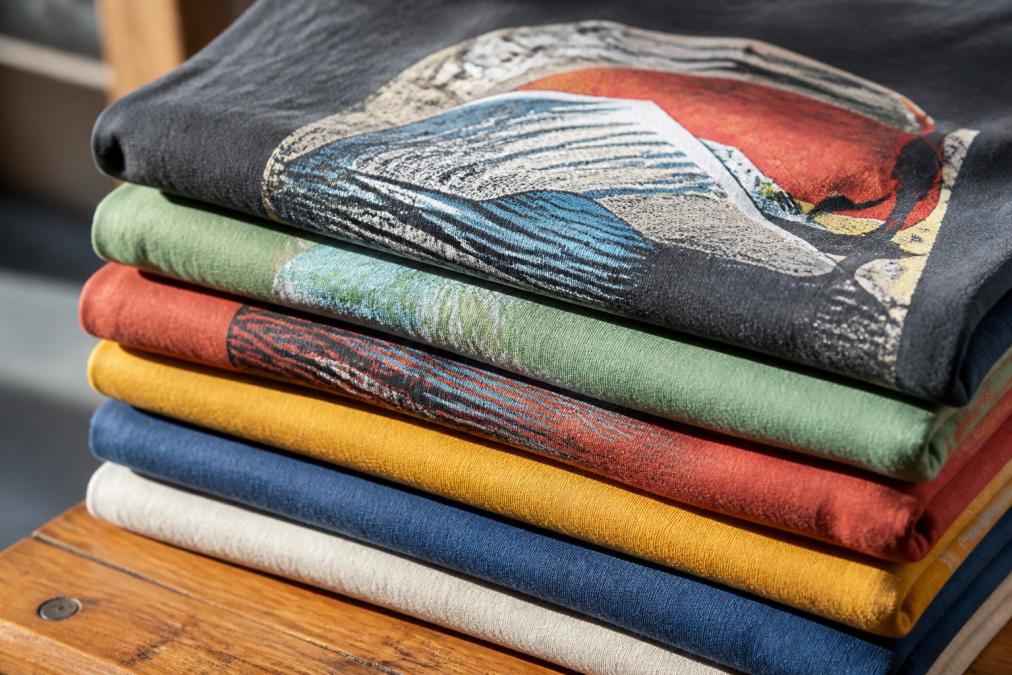
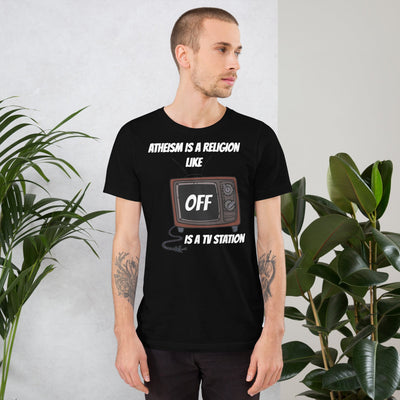
The Halloween unisex tee we carry at The Wits End uses 100% combed and ring-spun cotton at 4.2 oz./yd.² with pre-shrunk fabric and shoulder-to-shoulder taping. Combed ring-spun cotton removes shorter, weaker fibers before spinning, producing a tighter, smoother surface that holds ink edges cleanly.

Fabric Composition Guide: What to Look For in 2026
Not all fabric compositions print equally. Here's how the most common options perform:
| Fabric Type | Print Surface | Best For | Durability |
|---|---|---|---|
| 100% combed ring-spun cotton | Excellent | Bold graphics, solid fills | High |
| Tri-blend (cotton/poly/rayon) | Good, soft hand | Vintage/distressed looks | Medium-high |
| 100% polyester | Challenging (dye migration) | Sublimation, not screen print | Medium |
| 50/50 cotton-poly | Moderate | Budget runs | Medium |
| Recycled cotton blend | Good | Eco-focused orders | High |
Fabric weight is critical. For screen printing, 4.0-5.5 oz./yd.² is the practical range. Below 4 oz., the fabric is too sheer for opacity without multiple ink passes. Above 6 oz., you're into heavyweight territory that limits softness.
When ordering inclusive sizes up to 5XL, verify that the blank manufacturer maintains consistent fabric weight and construction across the full size range.
Screen Printing vs Direct to Garment 2026: Cost, Quality, and Use Cases
Screen printing and direct-to-garment (DTG) printing solve different problems. Choosing the wrong one for your use case costs you money and quality.
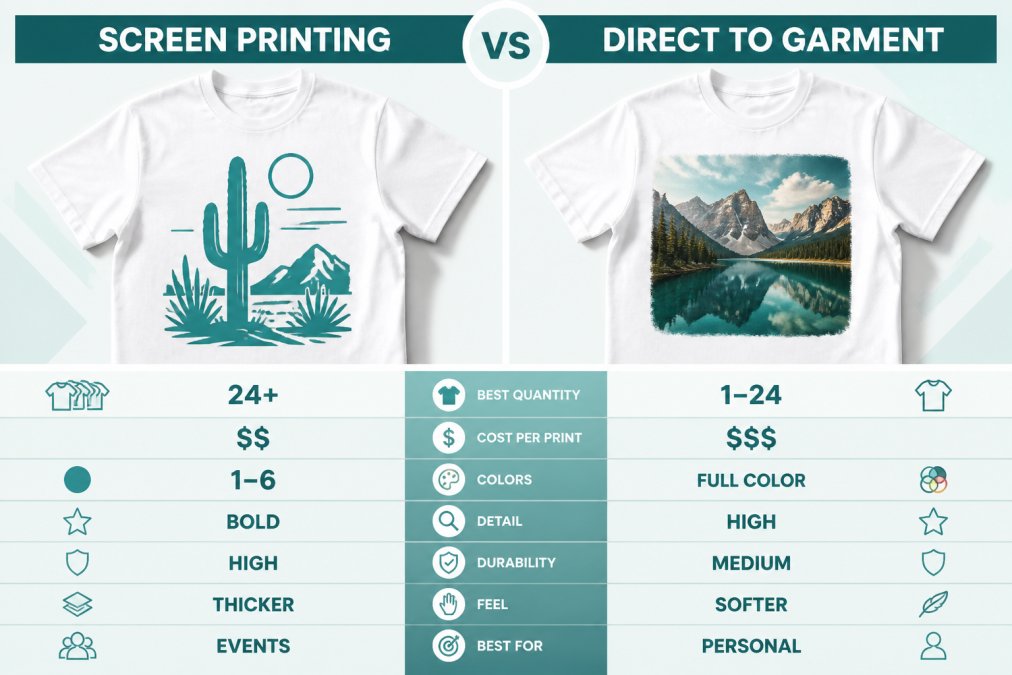
Screen printing pushes ink through a mesh screen. Each color requires a separate screen, meaning setup fees per color but very low per-unit costs at volume. Ink opacity is excellent and washability is industry-leading when printed correctly with proper curing.
DTG printing uses a modified inkjet printer to spray ink directly onto the garment. No screens, no setup fees per color, and full photographic color range from a single pass. The tradeoff is per-unit cost at volume and washability, which depends on pretreatment quality and ink type.
Cost-Benefit Analysis: Which Method Saves More Per Piece
The break-even point between screen printing and DTG typically falls around 24-48 units for a two-color design.
| Factor | Screen Printing | DTG |
|---|---|---|
| Setup cost | Per screen, per color | None |
| Best order size | 24+ units | 1-23 units |
| Color complexity | Limited by screen count | Unlimited |
| Ink opacity on dark garments | Excellent | Requires pretreatment |
| Washability | Excellent (plastisol) | Good (varies by pretreatment) |
| Vintage/distressed effects | Native | Simulated |
| Print-on-demand compatibility | Low | High |
For on-demand printing, DTG is practical. For bulk printing with bold, limited-color graphics, screen printing wins on cost and durability. DTF (direct-to-film) transfers sit between the two: no screen fees, better opacity than DTG on dark garments, and decent washability, though long-term durability trails plastisol screen printing.
No Minimum Screen Printing 2026: Who It's Actually For
No minimum screen printing in 2026 is almost always DTG or DTF printing rebranded for marketing clarity. True screen printing without minimums is rare because setup fees make single-unit screen printing cost-prohibitive.
No minimum order requirements serve a real audience: individual buyers, artists testing designs before committing to a run, small businesses needing a handful of staff shirts, and anyone ordering inclusive sizing where total units across sizes are naturally low. The honest trade-off is per-unit cost. For buyers who know they want 50+ units of the same design, a traditional screen print run will almost always cost less per piece.
According to the Specialty Graphic Imaging Association's industry overview, print-on-demand and short-run digital printing have grown consistently as technology and buyer expectations have shifted toward personalization over standardization.
Design File Preparation Guide for Custom Screen Printed Apparel
Most print quality problems start with the design file, not the printer.
For screen printing, the ideal file is a vector graphic (AI, EPS, or SVG format) with colors separated into distinct layers, one per screen. Each color should be a solid, flat fill with no gradients unless you're specifically requesting halftone simulation. For raster elements, 300 DPI at print size is the minimum.
For DTG and DTF, a high-resolution PNG with a transparent background is standard. 300 DPI at actual print dimensions. RGB color mode for most DTG printers, though confirm with your specific printer.
Common file preparation mistakes that cause print failures: thin strokes under 1 pt that disappear or bleed, fonts left as live text rather than converted to outlines, low-resolution raster images, colors specified in RGB when the printer expects spot color references, and missing bleed areas on all-over print designs.
The Pantone color matching system reference is the industry standard for specifying screen print ink colors. When color accuracy matters, provide a Pantone reference number rather than an RGB or hex value.
Sustainability Certifications and Eco-Friendly Inks to Know
Sustainability certifications in apparel have a credibility problem: there are many of them, they overlap, and some are more meaningful than others. Here's a practical breakdown of the ones that actually matter for custom screen printed apparel in 2026.
GOTS (Global Organic Textile Standard): The most comprehensive certification for organic textiles. Covers fiber production, processing, manufacturing, and labeling.
OEKO-TEX Standard 100: Tests for harmful substances in finished textiles. Every component has been tested against over 100 harmful substances. This is the certification most relevant to the final printed garment, including the inks.
Bluesign: Focuses on resource efficiency and chemical safety in textile manufacturing.
Phthalate-free plastisol: Not a certification but a specific ink formulation. Most quality printers now default to phthalate-free formulations.
Water-based inks: Lower VOC emissions during printing and easier environmental cleanup than solvent-based systems. The trade-off is slightly lower opacity on dark garments without an underbase and longer cure times.
For buyers who prioritize sustainability, the practical checklist is: GOTS or OEKO-TEX certified blank, water-based or phthalate-free plastisol inks, and a printer that can document their ink suppliers.
Turnaround Times, Washability, and Print Durability Expectations
Turnaround time for custom screen printed apparel varies based on order size, print complexity, and whether you're ordering through print-on-demand or a traditional screen printer. Print-on-demand and DTG orders typically ship within 3-7 business days. Traditional screen printing generally takes 7-14 business days, longer during peak seasons.
Washability is where screen printing earns its reputation. Properly cured plastisol ink on a quality blank should survive well over 50 wash cycles without significant fading or cracking, provided the garment is washed inside-out in cold water and not dried on high heat. Water-based inks require even more careful curing but produce a softer hand that many buyers prefer.
A properly cured print on a quality blank behaves very differently from undercured ink or low-quality plastisol, which is the most common cause of early cracking.
According to the American Apparel and Footwear Association's sustainability and quality resources, garment durability and care instruction accuracy are increasingly important consumer expectations in the decorated apparel category.
Print durability by method summary:
| Method | Expected Wash Cycles (before visible fade) | Care Sensitivity | Hand Feel |
|---|---|---|---|
| Plastisol screen print | 50+ | Low | Sits on fabric |
| Water-based screen print | 40-50 | Medium | Soft, absorbed |
| DTG | 25-40 | Medium-high | Soft |
| DTF transfer | 20-35 | High | Slightly raised |
| Heat transfer vinyl | 15-30 | High | Raised, stiff |
The challenge with custom screen printed apparel is that the number of variables, fabric, ink type, printing method, file quality, and curing process, means the difference between a shirt that lasts years and one that disappoints after a month comes down to decisions made before the first garment is printed. The Wits End approaches every order as a veteran-owned shop that has made those decisions deliberately: hand-screened and direct-to-garment printing on quality blanks, inclusive sizing through 5XL, and designs built for people who want their apparel to say something specific. Shop Now and see what that looks like in practice.
Frequently Asked Questions
What is the average cost to have a shirt screen printed in 2026?
Screen printing costs depend on order size, number of ink colors, and setup fees. Single-color prints on bulk orders of 24 or more shirts typically run $8-$15 per shirt, with setup fees of $20-$50 per color per screen. Smaller or no-minimum orders cost more per piece, often $18-$30, because setup costs spread across fewer units. Direct-to-garment orders skip setup fees entirely, making them more affordable for one-off custom screen printed apparel orders.
Which is better for custom designs: DTG or screen printing in 2026?
Screen printing wins on bulk orders where you need ink opacity, vibrant color on dark garments, and long-term washability. DTG printing is better for full-color photographic designs, one-off pieces, or orders with no minimum requirement. For 2026, many print-on-demand shops offer both. If your design uses more than four colors or fine photographic gradients, DTG is the practical choice. For bold, simple graphics on 12 or more shirts, screen printing delivers lower cost per piece and stronger ink durability.
What are the top apparel trends for custom screen printing in 2026?
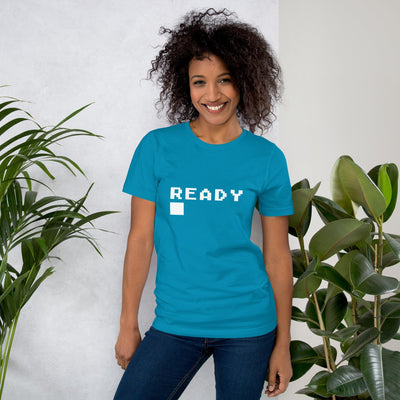
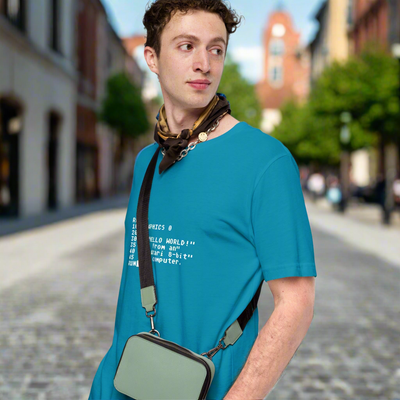
The dominant trends for custom screen printed apparel in 2026 are vintage aesthetics, retro color palettes (muted earth tones, faded pastels), and oversized fits on heavyweight blanks. Tri-blend fabrics are popular for their soft hand feel and slight heather effect that enhances vintage-look prints. Sustainability is also front and center, with buyers seeking blanks carrying OEKO-TEX or GOTS certifications. Geek culture and niche-interest graphics, including retro computing and ironic statement tees, are outperforming generic designs.
Is no-minimum screen printing worth it for small orders?
No-minimum screen printing is worth it when you need fewer than 12 shirts, want to test a design before committing to bulk printing, or are ordering one-of-a-kind pieces. The trade-off is a higher per-shirt price because setup fees are not offset by volume. Print-on-demand providers using DTF or DTG printing make no-minimum orders practical without sacrificing print quality. For ongoing small-batch custom apparel sourcing, finding a shop that specializes in on-demand printing keeps costs predictable.
How do I prepare a design file for screen printing or DTG printing?
For screen printing, submit vector graphics (AI or EPS format) at the final print size, with each color on a separate layer for color separation. Avoid gradients unless you plan to use halftone techniques. For DTG printing, a high-resolution PNG with a transparent background at 300 DPI works best. Check that your design placement measurements are included and confirm ink opacity requirements for dark garments. Poorly prepared files are the most common cause of print quality problems and added setup fees.
How do I know a screen printed shirt will hold up after multiple washes?
Washability depends on three factors: ink type, mesh count used during printing, and garment fabric weight. Plastisol inks cure at high heat and bond tightly to cotton fibers, making them the most durable option for repeated washing. Water-based and eco-friendly inks require proper curing to match that durability. Heavier fabric weights (4.2 oz./yd.² and above) hold prints better than thin blanks. Always wash printed apparel inside-out in cold water and avoid high-heat drying to extend print life.
This article was written using GrandRanker