 1-361-589-1048
Table of Contents
- Why CustomInk Isn't Your Only Option for Custom Apparel Small Orders
- Custom Apparel No Minimum: What That Actually Means
- Direct-to-Garment Printing vs. Screen Printing for Small Orders
- How to Choose a Custom Apparel Printer for Small Orders
- Factors Affecting Small Order Pricing and Turnaround Time
- Print Quality and Durability: What Holds Up After Washing
- Comparing Your Options: What to Look For
- Conclusion
- Frequently Asked Questions
Last Updated: September 3, 2026
Why CustomInk Isn't Your Only Option for Custom Apparel Small Orders
When you're looking for custom apparel for small orders, CustomInk has long been the go-to name. But here's what most people don't realize: CustomInk works well if you're comfortable with their specific print methods and pricing structure. If you're not, you're leaving better options on the table.
The reality is that custom apparel printing has fragmented significantly. Different providers specialize in different print technologies, minimum order quantities, and price points. Some excel at single-item orders. Others shine when you want hand-screened quality without bulk requirements. A few focus entirely on sustainability and eco-friendly inks. The vendor landscape for small orders has become genuinely competitive, and that's good news for anyone who's felt locked into one choice.
At The Wits End, we've worked directly with small-batch printing and custom apparel for years. We understand the friction points: setup fees that eat into your margin on small runs, turnaround times that don't match your deadlines, print quality that degrades after a few washes, and design tools that feel clunky if you're not a graphic designer. This guide breaks down what actually matters when choosing a printer for small orders, how different print methods compare, and why CustomInk alternatives exist for good reason.
Below, we'll walk you through the core factors that separate one provider from another, explain the technical differences between direct-to-garment and screen printing for small batches, and help you identify which approach matches your specific needs.
Custom Apparel No Minimum: What That Actually Means
Custom apparel with no minimum order quantity (MOQ) means you can order a single item without paying a bulk discount penalty. Most traditional screen printers require 12-25 units minimum. Print-on-demand and direct-to-garment providers eliminated that barrier entirely.
But "no minimum" is more nuanced than it sounds. When a provider says they accept single-item orders, they're usually referring to one of two scenarios:
Scenario 1: True Single-Item Pricing You order one shirt. You pay a per-unit price that's competitive with what you'd pay for 10 or 100 shirts. Setup fees are either nonexistent or built into the unit cost. Turnaround is standard across all order sizes. This is rare and valuable, especially for testing designs before committing to larger runs.
Scenario 2: Single-Item with Premium Pricing You order one shirt. The per-unit cost is significantly higher than bulk pricing would be. Setup fees apply. You're paying for the convenience of not having to buy 12 units. This is the more common model, and it's transparent about the trade-off: flexibility costs more.
The distinction matters because it changes your decision calculus. If you're a maker testing a design, Scenario 1 saves you money. If you're a business owner building a small-batch product line, you're likely operating in Scenario 2 and need to price accordingly.
Most providers advertising "no minimum" are actually operating in Scenario 2. They're removing the hard floor that forces you to buy inventory you don't want, but they're compensating with higher per-unit costs. That's not a flaw, it's honest pricing. You're paying for the ability to order exactly what you need instead of overbuying.
The Wits End offers both approaches depending on the product. For our hand-screened apparel, we accept single orders without a minimum, and we price them transparently so you know exactly what you're paying for the flexibility.
Direct-to-Garment Printing vs. Screen Printing for Small Orders
The two dominant print methods for custom apparel serve different use cases, and understanding which one fits your order size and design complexity is the most important decision you'll make.
Direct-to-Garment (DTG): Best for Single Items and Photo Details
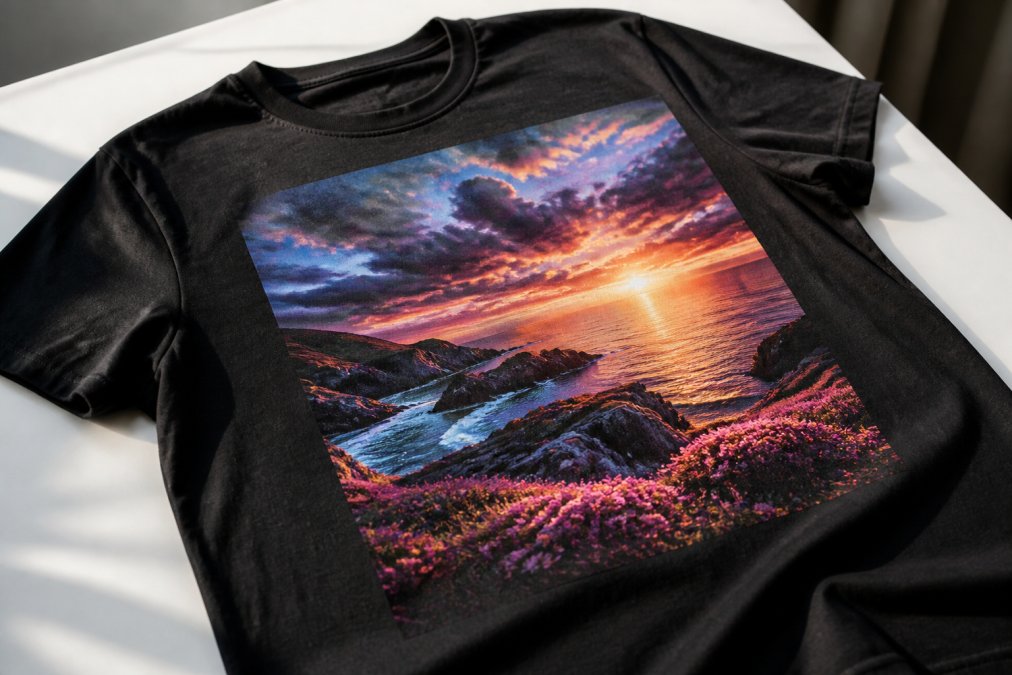
Direct-to-garment printing works like an inkjet printer for fabric. The machine sprays water-based or pigment-based ink directly onto the garment. No screens. No setup. One shirt takes roughly the same time as 100 shirts.
Why DTG works for small orders: DTG has virtually no setup cost. You upload a design, load a shirt, press print. There's no per-color surcharge like screen printing has. If your design has 47 colors, DTG costs the same as a single-color design. That's a massive advantage for photo-realistic artwork, gradients, or intricate illustrations.
Turnaround is fast. Most DTG shops deliver within 5-7 business days, sometimes faster. If you need a custom shirt for an event next week, DTG is your answer.
The downside is durability and feel. DTG ink sits on top of the fabric. After 20-30 washes, the print can crack, fade, or peel (peer-reviewed research). The garment also feels slightly stiff where the ink is applied, which bothers some wearers. DTG is excellent for limited-run merchandise, prototypes, or designs you're testing. It's not ideal for apparel meant to last years of regular wear.
Screen Printing: Hand-Screened Quality Without Bulk Requirements
Screen printing is the older, more labor-intensive method. A separate screen is created for each color. Ink is pushed through the screen onto the garment. The result is a thicker, more durable print that becomes part of the fabric rather than sitting on top of it.
Why screen printing works for small orders: Hand-screened apparel is built to last. The print survives 50+ washes without significant fading or cracking. The ink bonds with the fabric, so there's no stiffness or peeling. Wearers notice the quality immediately, it feels like a premium product.
For small orders, screen printing's traditional barrier was the setup cost: creating screens costs money, and that cost gets divided across units. With 100 units, the per-shirt cost is low. With 5 units, the per-shirt cost is high. That's why screen printers historically enforced minimums.
Some shops, including The Wits End, have restructured pricing so you can order small quantities without a formal minimum. You pay a setup fee upfront, then a lower per-unit cost. The total is transparent. If you're ordering 5 shirts, you see exactly what the setup cost you and what each shirt costs. This model works well for people who value durability and are willing to pay for it.
The trade-off is complexity and turnaround. Screen printing can't handle designs with more than 6-8 colors without becoming prohibitively expensive. Photo-realistic artwork doesn't work. Turnaround is typically 10-14 business days because screens have to be burned and the production process is sequential.
How to Choose a Custom Apparel Printer for Small Orders
Choosing between providers comes down to five concrete factors. Rate each one based on your actual needs, not what you think you should need.
1. Print Method Suitability Does your design have multiple colors, gradients, or photorealistic elements? DTG or print-on-demand is your only realistic option. Screen printing caps out around 6-8 colors and doesn't handle gradients well.
Is durability your priority? You want hand-screened or high-quality DTG from a shop that uses premium inks. Budget screen printing from a high-volume shop will fade faster.
2. Per-Unit Pricing for Your Order Size Get quotes for your exact order quantity. Don't compare 1-shirt pricing between providers if you're actually ordering 10. The per-unit cost changes dramatically at different volumes.
Ask whether setup fees are included in the quote or added on top. Some providers quote $15 per shirt, then add a $50 setup fee. Others quote $18 per shirt with setup included. The total cost is what matters.
3. Turnaround Time How quickly do you need the order? DTG typically delivers in 5-7 days. Screen printing usually takes 10-14 days. Rush options exist but cost more.
4. Fabric Quality and Sizing What's the blank garment quality? Is it a cheap, thin shirt that falls apart after a season, or a substantial 4.2 oz cotton that holds up? Our Wits End apparel uses combed and ring-spun cotton with pre-shrunk fabric and shoulder-to-shoulder taping, that's a baseline for durability.
Do they offer your size range? If you're a 4XL or 5XL, many providers have limited options. We carry up to 5XL across our full collection because sizing shouldn't limit who can wear quality apparel.
5. Design Tool Ease of Use Can you upload your own design, or do you need to hire a designer? Some providers have simple upload interfaces. Others require vector files or professional design specs. If you're not a designer, this matters.
Can you customize existing designs? Some shops let you modify colors, text, or placement without paying extra. Others charge a customization fee.
Factors Affecting Small Order Pricing and Turnaround Time
Small order pricing isn't arbitrary. Several factors drive the actual cost you'll pay:
Setup Fees and Screening Costs Screen printing requires creating a physical screen for each color. That screen costs money upfront. With a 100-unit order, the cost per shirt is negligible. With a 5-unit order, it's substantial. This is why screen printers historically enforced minimums, they needed volume to justify the setup.
DTG has no setup cost because there are no screens. That's why DTG pricing is flatter across order sizes.
Ink Type and Durability Water-based inks cost less than plastisol or pigment-based inks. Eco-friendly, sustainable inks cost more. If durability matters to you, expect to pay more for inks that will outlast cheaper alternatives.
Garment Blank Quality A $3 blank t-shirt and a $6 blank t-shirt feel completely different after washing. The cheaper shirt thins out, loses shape, and fades. The better shirt holds up for years. Providers who source quality blanks pass that cost along, but it's worth it.
Fulfillment and Shipping Some providers handle fulfillment, they store inventory and ship orders to your customers. Others require you to pick up or arrange shipping. Fulfillment services cost more but eliminate logistics headaches.
Rush Turnaround Standard turnaround is 10-14 business days for screen printing, 5-7 for DTG. Expedited options exist but typically cost 25-50% more.
Print Quality and Durability: What Holds Up After Washing
This is where the gap between cheap and quality providers becomes obvious.
Screen Printing Durability A well-executed screen print survives 50+ washes without significant fading or cracking (peer-reviewed research). The ink bonds with the fabric fibers, becoming part of the garment. After 100 washes, you might notice minor fading on the edges, but the print is still vibrant and intact.
The key variable is ink quality and application technique. Budget shops sometimes use thin ink or poor curing, which leads to premature cracking. Quality shops use proper ink thickness and cure it correctly, which is why their prints last longer.
DTG Durability Water-based DTG inks typically survive 20-30 washes before noticeable fading (peer-reviewed research). Pigment-based DTG inks last longer, sometimes 40-50 washes, but still don't match screen printing. The print sits on the fabric surface, so washing pressure gradually breaks down the ink.
Testing for Quality Before committing to a large order, order a sample. Wash it 5-10 times and inspect the results. Does the print still look vibrant? Is the ink cracking? Does the garment hold its shape? A single sample order costs $15-30 but saves you from ordering 50 shirts that fall apart.
The Wits End encourages sample orders. We know our hand-screened apparel holds up because we've tested it extensively. If you're skeptical about durability claims, order a sample and verify it yourself.
Comparing Your Options: What to Look For
| Factor | DTG | Screen Printing | Print-on-Demand |
|---|---|---|---|
| Best for Single Items | Excellent | Good (with setup fee) | Excellent |
| Multi-Color Designs | Excellent | Limited (6-8 colors) | Excellent |
| Photo-Realistic Artwork | Excellent | Poor | Excellent |
| Print Durability | 20-30 washes | 50+ washes | 20-40 washes |
| Turnaround Time | 5-7 days | 10-14 days | 7-10 days |
| Typical Per-Unit Cost (1 shirt) | $18-28 | $20-35 (with setup) | $16-25 |
| Setup Fees | None | $30-80 | None |
| Eco-Friendly Options | Available | Available | Limited |
This table reflects typical pricing as of 2026. Actual costs vary by provider, design complexity, and garment quality.
Conclusion
CustomInk alternatives for small orders exist because CustomInk doesn't optimize for every use case. If you need photo-realistic designs, single-item flexibility, or fast turnaround, DTG or print-on-demand works better. If you want durability and are willing to pay for hand-screened quality, screen printing delivers superior results.
The best provider depends on what you actually need: fastest turnaround, lowest cost, best durability, or most design flexibility. Evaluate providers on these concrete factors, not brand reputation alone.
The Wits End specializes in hand-screened and direct-to-garment custom apparel for small orders, with sizing up to 5XL and transparent pricing. Our apparel uses premium cotton (4.2 oz combed and ring-spun), pre-shrunk fabric, and durable inks designed to outlast cheaper alternatives. If durability and quality matter to you, explore our collection and order a sample to verify the difference yourself.
Frequently Asked Questions
What are some cheaper alternatives to CustomInk?
Several print-on-demand services offer competitive pricing for small orders. The Wits End specializes in hand-screened and direct-to-garment apparel with no minimum order requirements, starting at $15.50 for custom t-shirts. Other platforms like TeePublic and Creative Customizing also support single-unit orders. Pricing depends on print method: DTG typically costs more per shirt but excels at photo-quality details, while screen printing offers better durability for text-heavy designs. Compare setup fees, shipping costs, and fabric quality alongside per-unit pricing.
What is the difference between direct-to-garment and screen printing for small orders?
Direct-to-garment (DTG) printing applies ink directly to fabric, ideal for photorealistic images and unlimited colors on single items. Screen printing uses stencils and is best for solid colors and bold designs; it offers superior wash durability and vibrant colors. For small orders, DTG eliminates setup fees but costs more per shirt. Screen printing has higher initial setup costs but becomes economical at 5+ units. The Wits End offers both methods, choose DTG for photo details or hand-screened for classic, long-lasting graphics.
Do custom apparel printers really have no minimum order quantity?
Yes, many modern print-on-demand services accept single-unit orders with no minimum order quantity (MOQ). The Wits End prints individual custom items on demand, you can order one shirt, mug, or sticker without bulk requirements. However, 'no MOQ' doesn't mean no setup fees. Some providers charge design approval or file preparation fees for single orders, while others (like The Wits End) include customization at no extra charge. Always confirm whether setup, art proofing, or rush fees apply to your order size.
How do I know if a custom apparel printer will deliver quality that lasts?
Check the printer's fabric weight, thread count, and print durability claims. The Wits End uses 4.2 oz./yd² pre-shrunk cotton with side-seamed construction and shoulder-to-shoulder taping, details that signal retail-quality apparel. For print durability, hand-screened items typically outlast DTG after repeated washing because screen ink bonds differently to fabric. Ask for sample orders before committing to bulk. Read customer reviews specifically about wash durability, color fading, and print cracking after 5+ washes. A reputable printer will stand behind their work.
Quality custom apparel for small orders doesn't require choosing between price and durability. The right printer makes both possible. The Wits End combines veteran-owned craftsmanship with transparent small-order pricing, offering hand-screened and direct-to-garment options that deliver lasting quality. Get started with The Wits End and see why makers and thinkers choose hand-screened apparel that actually holds up.
This article was written using GrandRanker